
“It is impossible for a man to learn what he thinks he already knows.”
— Epictetus
Chasing Influence: Transformational Coaching to Build Champions for Life and What’s Your Juice? Unlock the Energy that Transforms Performance, Fuels Purpose, and Ignites the People Around You are now available on Amazon and Audible!
Waiting for Orders
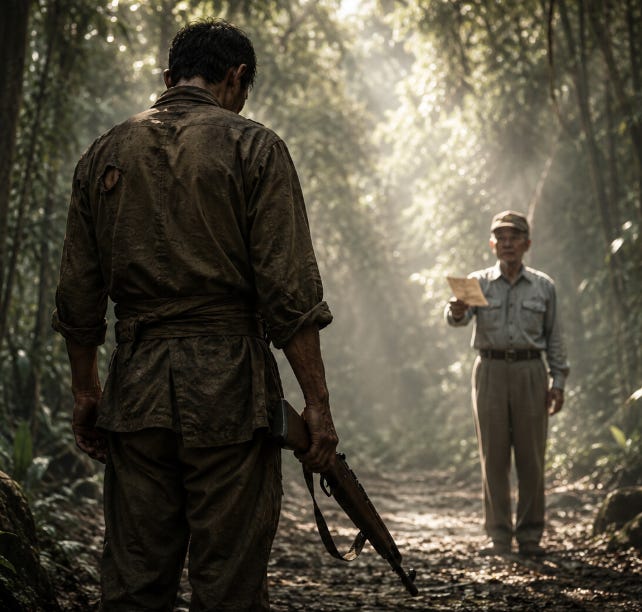
In March of 1974, somewhere in the Philippine jungle, a man stepped out of the jungle. He’s thin, weathered, carrying a rifle he hasn’t put down in decades. His uniform is worn but intact, his posture is rigid, and his eyes are steely with resolve.
He’s been waiting, not to be rescued, but for World War II orders he never received.
Nearly thirty years earlier, Hiroo Onoda had been given a simple command: hold your position, never surrender, and never stop fighting. Onoda seems to have taken these orders pretty seriously … and he followed them to the letter. When leaflets were dropped from planes telling him the war was over, he thought it was enemy propaganda. When his own family sent messages begging him to come home, he assumed they’d been coerced. When former comrades searched for him and pleaded with him to stand down, he turned them away too—because none of it came from the one person who had the authority to end it.
Then, in 1974, that person finally came. Onoda’s former commanding officer, now an elderly man living a civilian life, made the journey into the jungle, stood in front of his soldier, and issued the only order that could end the war. Stand down.
Onoda wept and laid down his rifle. Just like that, the war was finally over. It didn’t end with a climactic battle, but rather with a long-overdue change in beliefs.
For nearly thirty years, the truth had been delivered to him in every form imaginable. However, long before any of those leaflets fell, Onoda had decided what truth was allowed to look like. His belief became a filter, screening out anything that contradicted it. He was certain of that truth, and that certainty made him unreachable.
His story is incredible and unbelievable in many ways. The pattern is not.
About a century earlier, a Hungarian physician named Ignaz Semmelweis noticed something that should have been obvious to everyone around him. Women in maternity wards were dying at alarming rates—especially where doctors moved directly from performing autopsies to delivering babies. His solution was simple: wash your hands. When doctors in his ward began doing so, the death rates dropped nearly overnight.
Yet, amazingly, the medical community rejected Semmelweis's findings and recommendations. The implications of his findings meant doctors had been unknowingly causing harm, and they were unwilling to accept that as truth. So they made arguments against him and continued on. Semmelweis died discredited. They couldn’t adjust their beliefs, no matter the evidence or the harm. It was the same filter, in a different jungle.
There’s a part of Onoda’s story that’s easy to skip past, but we shouldn’t. During those thirty years, he was still fighting a war inside his own mind … and in the jungle around him. Filipino civilians and soldiers were killed. His loyalty caused real harm, making this more than a story about remarkable persistence. It’s a story about what happens when commitment outlasts truth.
We have all seen versions of this that didn’t happen in hospitals or jungles. They happen in conference rooms, team meetings, and side conversations. A leader clinging to a strategy that stopped working years ago, who doesn’t know how to call it off. A team executing a plan everyone privately knows is broken, because no one wants to be the person who says so out loud. A person staying in a role, a relationship, or a version of themselves they’ve already outgrown—waiting for someone else to give them permission to move on. It’s not about effort or discipline. It’s about being clear-minded enough to let the signal get through and to notice and adapt to the ever-changing world around us.
Belief is the most powerful tool we possess. It can carry you through things that would stop most people in their tracks. But when belief stops adapting, it stops serving, and when it hardens into our identity, it stops listening altogether. Truth remains available; we just need to know how to recognize it when it’s standing right in front of us.
Are you still fighting a war that’s already over? And, are the people around you able to reach you if you are?
“Nothing is more dangerous than an idea when it is the only one you have.”
— Émile Chartier
Connecting this quote to the story. Onoda’s unwavering loyalty to a single belief, that the war was still being fought, made him unable to recognize the truth even when it was repeatedly presented to him.
This week’s Chasing Influence tip: If your team can’t challenge the plan, the plan becomes the problem.