
“What lies behind us and what lies before us are tiny matters compared to what lies within us.”
— Ralph Waldo Emerson
A day early this week, and here's why. Today is your last chance to grab a free Kindle copy of What's Your Juice? or Chasing Influence. I wanted to make sure you saw it before the window closed. Enjoy the read, and then scroll down for this week's post on Jim Thorpe. I hope you like it!
Chasing Influence: Transformational Coaching to Build Champions for Life and What’s Your Juice? Unlock the Energy that Transforms Performance, Fuels Purpose, and Ignites the People Around You are now available on Amazon and Audible!
Wa-Tho-Huk
This time of year, courts, fields, stadiums, tracks, and courses are full of trophies, plaques, handshakes, and names read aloud over PA systems. It’s a time to recognize and celebrate impressive accomplishments.
For a few weeks every spring, recognition feels like the whole point. Maybe it is. Maybe it isn’t. This week’s message shares the story of Wa-Tho-Huk.
You may not know that name. Most people don’t. But you probably know who he became. His name in English: Jim Thorpe.
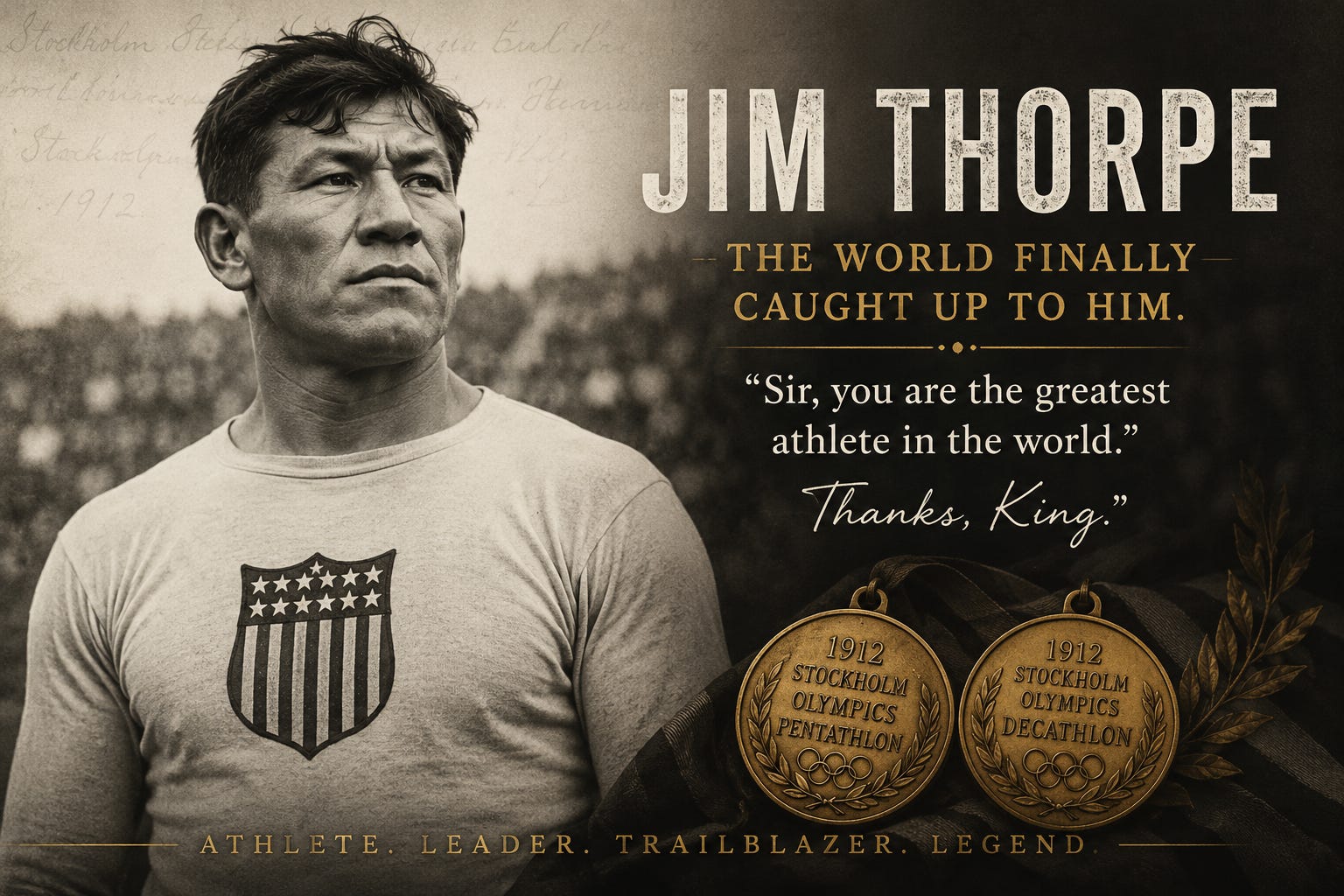
In the summer of 1912, in Stockholm, Sweden, King Gustav V placed a laurel wreath on the head of this young man from the Sac and Fox Nation of Oklahoma and said, “Sir, you are the greatest athlete in the world.”
Jim Thorpe looked at the king and said, “Thanks, King.”
At that moment of pagentry, accolade, and celebration … that was Jim Thorpe. No theatrics, witty reply, or headline-generating moment. Just a man who stayed true to who he was, even with the world watching.
But to understand why that moment matters … and why it still matters today … let’s go back a little further.
Jim Thorpe was born on May 28, 1888, in a one-room Oklahoma cabin in what was then labeled Indian Territory. He was a member of the Sac and Fox Nation. It wasn’t an easy childhood. By the time he was nine, he had lost his twin brother to pneumonia. His mother died when he was eleven, and his father when he was sixteen. Thorpe was sent, as so many Native American children were at that time, to the Carlisle Indian Industrial School in Pennsylvania. It was an institution built on the explicit mission of stripping Indigenous children of their language, their culture, and their identity. The school’s founder described his philosophy with stunning cruelty: “Kill the Indian, save the man.”
That was the world pressing down on Jim Thorpe from every direction. And yet something in him would not let it happen.
At Carlisle, he became one of the most electrifying football players in the country. He played every sport he touched with a recklessness and joy that looked natural, almost effortless. In the summer of 1909, between school sessions, he headed to Rocky Mount, North Carolina, and played semi-professional baseball for a small regional league, making a meager $25 a week.
By 1912, Jim Thorpe could be argued as being the best all-around athlete on the planet. At the Stockholm Olympics, he entered both the pentathlon and the decathlon. He won both. His decathlon victory was so dominant it redefined the event. After King Gustav placed the wreath on his head and spoke those now-famous words, the crowd roared for minutes.
Jim Thorpe, the kid from a one-room cabin in Indian Territory, was the greatest athlete in the world. And the world knew it. Then, they took the medals back.
A newspaper in Worcester, Massachusetts published a story revealing that Jim had played semi-professional baseball in North Carolina in 1909. Under the strict amateur rules of the time, accepting payment for athletic participation made an athlete ineligible for Olympic competition. The Amateur Athletic Union investigated. The IOC concurred. The consequence of making $25 a week was being scrubbed from the record books.
Thorpe wrote a letter to the AAU. He explained that he hadn’t understood the rules, that he had played ball as so many other young men did without any thought of his amateur status. He asked for understanding.
He was denied.
Jim Thorpe kept his head up, signed with the New York Giants and played six seasons of Major League Baseball. He played professional football and became the first president of the league that would eventually become the NFL. He kept showing up, and he kept competing. Thorpe brought his full effort to every arena that would have him — which wasn’t a given at the time.
There’s a danger in seeing ourselves only through the reflection of how institutions, critics, or other people define us. Jim Thorpe refused to let his Olympic records — and disappointments — define him.
He died in 1953 and never got the medals back in his lifetime.
In 1983, thirty years after his death, the IOC partially restored his recognition. It wasn’t until July 2022 — one hundred and ten years after his historic victories in Stockholm — that the International Olympic Committee officially updated the record to name Jim Thorpe as the sole gold medalist in both the decathlon and the pentathlon.
It took 110 years to get it right.
We all have our own version of this. Maybe not at this scale, but in ways that cut just as deep. You did something remarkable. And someone with authority found a reason to question it, diminish it, or erase it. In moments like that, the instinct today is to rage, hold a grudge, feel wronged, look for someone to blame, or declare that the world has it out for you personally.
The truth is, Jim Thorpe lived in a world that did have something against him. It wasn’t an excuse; it was a fact. He had every reason to burn with it.
Yet he didn’t.
We don’t all face what Jim Thorpe faced. But we do all get to choose our path — through the setback, the slight, the stripped title, the award that went to someone else, the recognition that never came. The path remains ours to pick.
Jim Thorpe took a different path and kept showing up regardless of what any scoreboard or record book said. The medal was taken. His mettle was never theirs to have.
Your worth carries the same great value; you don’t need a medal or ribbon to validate what’s good about life, the joys of each day, and the love around us.
This past Thursday would have been Jim Thorpe’s 137th birthday. The IOC finally got it right. Jim Thorpe always did. So should you.
“Success is peace of mind in knowing you did your best to become the best you are capable of becoming.”
— John Wooden
Connecting this quote to the story. True success isn't determined by medals, records, or recognition. It’s determined by the peace of knowing you gave your absolute best—even if others fail to acknowledge it.
This week’s Chasing Influence tip: When others misjudge your value, keep showing up anyway. Consistency outlasts criticism.