
“What is important is seldom urgent, and what is urgent is seldom important.”
— Dwight D. Eisenhower
What’s Your Juice? Unlock the Energy that Transforms Performance, Fuels Purpose, and Ignites the People Around You is now available on Amazon and now on Audible!
The Trap of the Urgent
I had this Post-it note on my desk for the longest time with an idea for future exploration. It simply said: Eisenhower Matrix. I’m not sure exactly when I wrote it. It’s been long enough that it isn’t so sticky anymore, it’s started to fade, and the corners have turned. Every now and then I’d look at it, think yes, I need to do that, and then something more pressing would show up and I’d move on.
So here we now are. The note has finally won. And I have a new appreciation for its irony.
Eisenhower had a note of his own.
He had written it the night before the invasion, folded it, and kept it in his pocket. It accepted full personal responsibility if D-Day failed. While thousands of details screamed for his attention—changing weather reports, incomplete intelligence, the staggering logistics required to move 150,000 soldiers across the English Channel—Eisenhower had already done the thing only he could do. He had made the decision and quietly prepared to own the outcome, whatever it was. His attention was on what mattered the most.
Later in life, Eisenhower distilled his approach into a simple framework, known as the Eisenhower Matrix. It sorts the demands on our time into four categories: urgent and important, important but not urgent, urgent but not important, and neither.
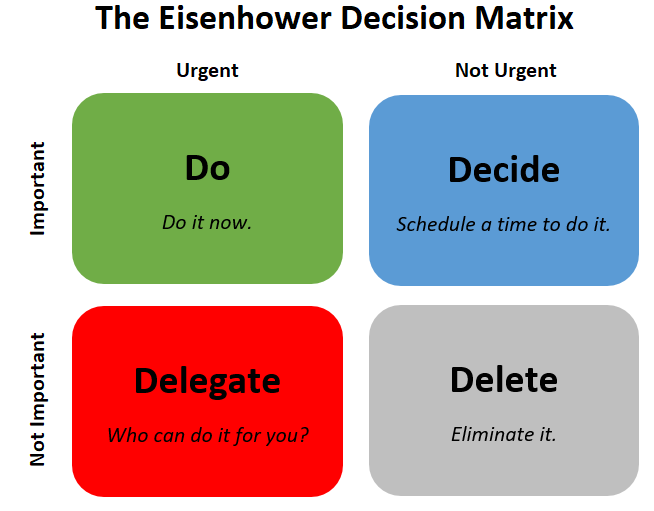
Most of us bounce between the urgent categories. Emails, notifications, deadlines, requests … our days fill quickly with things that feel pressing but don’t really move our lives forward.
I’ll be honest, for those who know me well, practicing patience can sometimes be a challenge. And I think I know why. Years of working as an activities director has programmed me to live in the urgent. The job demands it. There are scores of details that must be attended to … and accurately. One mistake can mean a team doesn’t show up, referees aren’t scheduled, a bus never arrives. And if that happens, a game doesn’t happen—a very public mistake that impacts and upsets hundreds of people, some of whom may have traveled a significant distance for an event that simply isn’t there. Most jobs don’t carry that kind of time-bound, public accountability. It trains you to be a firefighter, rushing from one burning issue to the next, and after enough years, urgency stops feeling like pressure. It starts feeling like purpose.
Someone put it this way recently, “The best thing about banging your head against the wall is the way it feels when you stop.” We laugh because we recognize it. Most of us spend entire days trying to finish urgent things, and we’ve confused the relief of stopping with the satisfaction of living in the moment.
Eisenhower knew that the most meaningful work, the kind that shapes who we become and what we leave behind, rarely screams for attention. It waits in that second quadrant: important but not urgent. And if we keep ignoring it, it doesn’t stay quiet forever. Urgency has a way of showing up loudly later when importance is neglected now.
The important things will never fight for your attention the way the urgent ones do. They don’t have that kind of voice. They need you to choose them.
Great leaders are disciplined about protecting space for what matters most—to think, prepare, and invest in others—because they understand that influence is built in important moments, not necessarily the urgent ones.
I’m glad I finally picked that Post-it note back up. The life you want, the relationships you value, the legacy you hope to leave—they rarely come from reacting. They come from choosing.
The fires will always be there. What I’ve learned—sometimes the hard way—is that the most important work has never asked me to hurry.
“The key is not to prioritize what’s on your schedule, but to schedule your priorities.”
— Stephen Covey
Connecting this quote to the story. Eisenhower’s success came from intentionally prioritizing and protecting time for the most important decisions, which would shape the outcome.
This week’s Chasing Influence tip: Consciously guard time for what is important before urgency steals it from you.
Another winner - our lifestyle needs more of this information- I hope all is well with you!