
“It’s not what happens to you, but how you react to it that matters.”
— Epictetus
What’s Your Juice? Unlock the Energy that Transforms Performance, Fuels Purpose, and Ignites the People Around You is now available on Amazon and now on Audible!
The Day My Luck Ran Out
I stood staring at a 21-foot pontoon on a trailer and a pristine 15-foot Cadillac fishing boat. Yes, it was a Cadillac (not the car company) … and this 1960s-vintage beauty was my restoration project. Both boats needed motors. The shop was over an hour away.
Simple math: Two trips meant four hours of driving. Home around midnight.
One trip with both boats? Home by 10pm.
The solution seemed obvious.
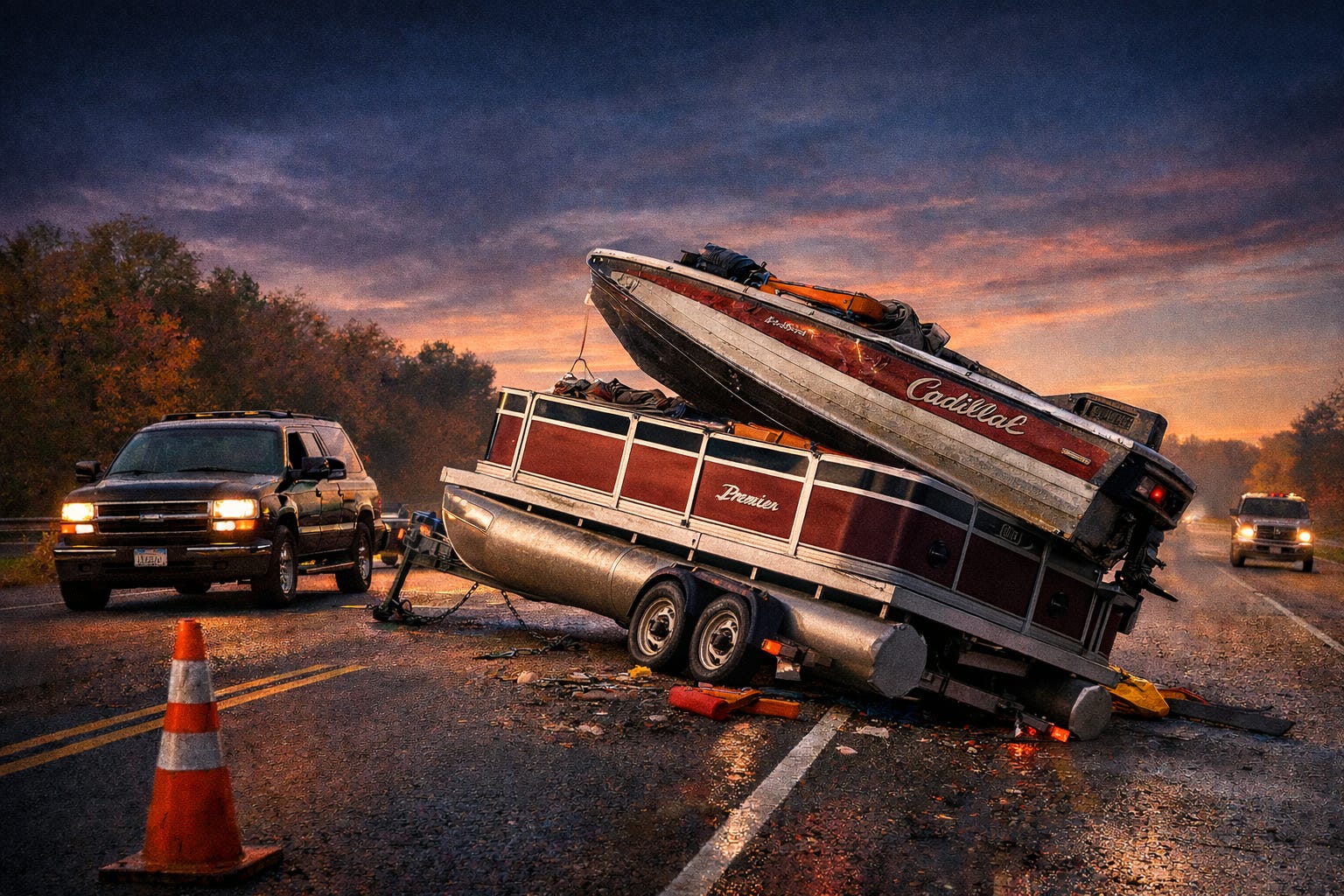
I should, of course, load the pontoon on the trailer, lay wood planks across it, and hoist the fishing boat on top. Six ratchet straps later, I had a two-story boat tower that would make an engineer proud (actually, probably wince).
The two guys who helped me lift it into place looked at me like I’d lost my mind.
“Voila!” I thought. “Brilliant.” (Narrator voice: It was not brilliant.)
The fall colors were stunning as I pulled onto the rural highway. My 2001 Suburban handled the load with ease. Then I noticed the wind gusts—whew, a bit stronger than I’d realized when I was sheltered at the cabin. At a curvy stretch, I decided to pull over to check the straps.
All good. Never a doubt. Away I went.
Google Maps directed me to turn left at a major four-lane highway intersection. I knew I would need a gentle turn with this cargo. I waited for an opening in traffic, eased into the left turn, and … the wind hit me broadside.
In slow-motion horror, I watched through my rearview mirror as my perfect plan tipped sideways. The boats slid off the trailer, still strapped together, and crashed onto their sides, right smack dab in the middle of the busy road. The trailer disconnected from my hitch, held only by safety chains, was now blocking the right lane of traffic.
Hazard lights on. Heart pounding. Don’t panic. Think.
Was this illegal? Am I about to get arrested? How on earth do I fix this? The boats are on their sides, off the trailer, and it took three of us to get them on there the first time!
Adrenaline kicked in. I unstrapped the boats. The fishing boat dropped to the pavement with a WHAP. Farmer strength activated, I dragged it deep into the ditch. Somehow, miraculously, it was unscathed.
Good Samaritans started pulling over to help the sorry sap, alone, with his boats tipped on their sides on the highway. Together we tipped the pontoon upright—WHAM!—and muscled it back onto the trailer. One helper asked, “You want the other boat back on th … ?”
I answered before he finished the sentence … “Nope. We’re good.”
Twenty minutes to the shop. I’d drop the pontoon and return for the fishing boat later. No cuffs, limited damage. Crisis averted. Sort of.
That was until my maps app led me to a dead-end street in a neighborhood where my boat repair guy said, “You’re WHERE?! Get out of there NOW.”
Wrong side of town. Twenty-one-foot boat. Single-lane dead end.
What else could go wrong?
I finally reached the shop after closing time, unloaded the pontoon in the cold dusk, and raced back for the fishing boat, now sitting deep in a ditch on a dark highway.
Half a mile out, I spotted police lights. A tow truck. At my fateful intersection.
Please don’t be my boat. Please don’t be my boat.
It was my boat. On the flatbed of the tow truck.
“That’s mine,” I told the officer. “Had a trailer issue earlier.” (Perhaps that was an understatement.)
“That’s between you and the tow truck operator now.”
$275 later—just for lifting it onto the truck—the boat was now back on my trailer.
I brought it to the boat shop, returned the rental trailer, and drove two more hours home. I pulled into my driveway just after midnight. Windy. Cold. Emotionally drained. Down $275.
One of the worst days of my life.
And honestly? I got lucky, and I learned something about stacking boats … and my pride.
I wanted to save two hours, but what I wanted most was to get both boats safely to the shop. The shortcut cost me more time, money, and stress than it would have doing things right.
At the same time, there was another important piece to the story: when everything went sideways—literally—I didn’t freeze, panic, or freak out. I solved problems. I focused on what I could control.
Separate the boats. Get help. Move forward. Figure it out.
Losing it in that moment wouldn't have moved a single boat off that highway. It would've just made me look even more ridiculous than I already did.
The shortcut created the disaster. The response under pressure got me through it.
Both matter.
Sometimes we choose convenience over wisdom. We stack boats that shouldn’t be stacked. We take shortcuts we know are risky. And when it all tips over in traffic, we get to choose our juice … panic and blame, or adapt and solve.
I’ve made peace with that $275 tow truck bill. It’s the price I paid for the reminder: do it right, or do it twice. And when you mess up? Keep moving. Keep solving. Keep pointing forward.
And when your perfect plan tips sideways, because it will, as a coach or leader, what energy will you bring to solve it? The choice remains yours!
“Discipline is choosing between what you want now and what you want most.”
— Abraham Lincloln
Connecting this quote to the story. My entire day was a live demonstration of Lincoln’s insight. I chose what I wanted now (speed, efficiency, being home earlier), and the lesson arrived when circumstances forced me to realign with what I wanted most: safety, responsibility, and the right response when my plan fell apart.
This week’s Chasing Influence tip: Panic spreads faster than problems—a steady response stops both.
Brilliant story that perfectly ilustrates the shortcut-to-crisis pipeline we all know too well. The distinction between solving the crisis vs preventing it is key, bc we often confuse good emergency response with good planning. I've definately made this mistake with project deadlines where fixing problems at 2am became my default instead of building in buffer time. What separates good leaders from mediocre ones is learning which fires never needed to happen.