

“The greatest obstacle to discovery is not ignorance—it is the illusion of knowledge.”
—Daniel J. Boorstin
Chasing Influence: Transformational Coaching to Build Champions for Life and What’s Your Juice? Unlock the Energy that Transforms Performance, Fuels Purpose, and Ignites the People Around You are available on Amazon and Audible!
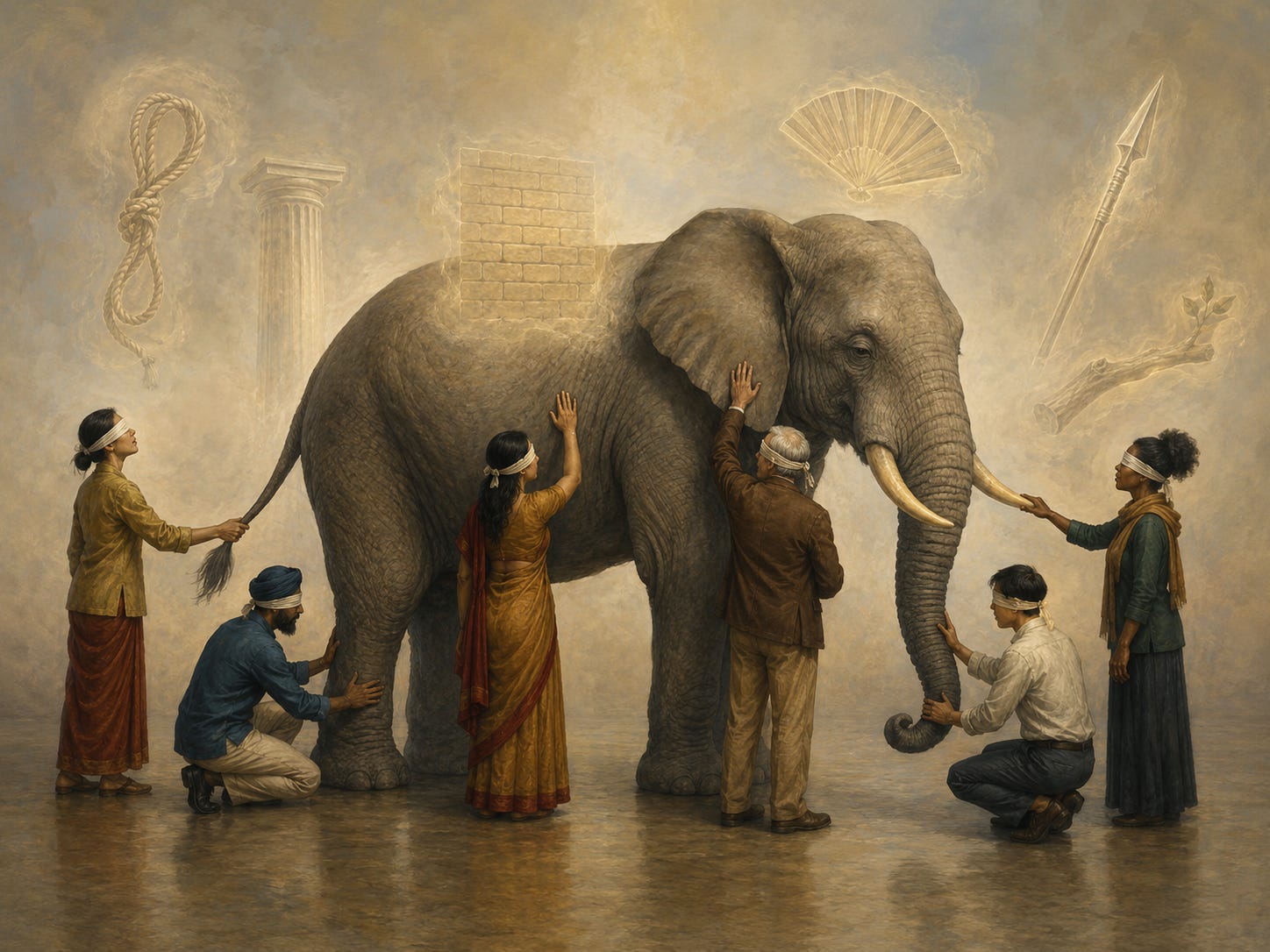
Long ago, so the old parable goes, six blind men heard that an elephant had come to their village. None of them had ever encountered one, so they walked out together to learn what an elephant was.
The first man reached out and wrapped his arms around a massive leg. “An elephant is like a pillar,” he said. The second man caught hold of the tail. “You’re mistaken. An elephant is like a rope.” The third felt the trunk curling through his hands and declared the elephant was like a thick branch. The fourth touched an ear and described a great fan. The fifth pressed his palms against the animal’s side and said the others had lost their minds—an elephant was plainly a wall. The sixth ran his fingers down a tusk and swore the elephant was a spear.
Then they argued. Each man had touched the elephant himself. Each man had evidence. Each man was sure he was right.
And every one of them was correct about the piece he touched. The leg does seem like a pillar. The tail does feel like a rope. The trouble started when each man decided his piece was the whole animal.
It’s the same trap we’ve all fallen into at one time or another.
My mother used to warn me about this, though she never really talked about elephants. Her warning was about words—the absolute ones. Always and never. “You always do this.” “She never listens.” “That kid will never change.” My mom was leery of those words, and she warned us to be careful with them. Absolutes take one moment and stretch it over a whole person.
We need to leave room for maybe.
Maybe there’s something I don’t know. Maybe the other person lived that moment differently than I did. Maybe my first read wasn’t the best one.
Maybe requires a settled kind of strength—the strength to hold a conclusion loosely, to say, “Here’s what I’m seeing,” without adding, “And there’s nothing more to see.” The best leaders I’ve been around make decisions with an open hand instead of a closed fist, and when new information arrives, they let it in.
Certainty makes that hard. Certainty feels wonderful—it’s fast, it’s clean, it lets us assign blame and move on. And sometimes we need to act with certainty. But once we’re certain about a person, we run the risk of no longer being curious about them. We touch the leg and spend the rest of the season looking for pillars.
The kid who seems distracted doesn’t need us jumping to conclusions. That kid might just need one question—“everything okay?”—that costs thirty seconds and can rewrite the whole script.
Leave room for maybe. Before you finish the sentence forming in your head about the athlete you’re trying to figure out, your most difficult parent, that person who seemed so rude—leave room for maybe. It can make all the difference in your outlook, mood, relationships, and the way you care for and lead others.
“The first principle is that you must not fool yourself—and you are the easiest person to fool.”
—Richard Feynman
Connecting this quote to the story. Once a leader forms a verdict about someone, it becomes easy to fool themselves by treating every new behavior as proof they were right.
This week’s Chasing Influence tip: Listen for words like always, never, everyone, and no one. They often signal that you have stretched one experience across an entire person or situation. Replace the absolute with a more accurate description of what actually happened.