

“Little strokes fell great oaks.”
— Benjamin Franklin
Chasing Influence: Transformational Coaching to Build Champions for Life and What’s Your Juice? Unlock the Energy that Transforms Performance, Fuels Purpose, and Ignites the People Around You are available on Amazon and Audible!
Finding Your Dwarf
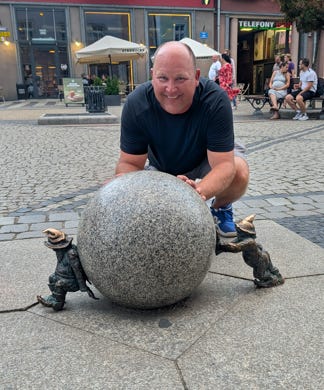
I crouched on a Wrocław sidewalk to have my picture taken with two little bronze men straining against a granite ball. I didn't know their names or their story. I'd noticed a few other small bronze statues on our walk and liked this one, so we snapped a photo and started to move on. As I stood up, I noticed the line that had quietly formed behind me, waiting for the same shot. It was days before I understood I'd been kneeling next to one of the truest things in the city.
Poland’s borders have moved, its governments have changed, and entire cities have changed nationalities. Few places show that better than Wrocław. Known as Breslau through most of its modern history, it was part of Germany when World War II began. In the war’s final months, German and Soviet forces fought an 80-day battle for the city that left much of it in ruins, and when Europe’s borders were redrawn, Breslau became Polish Wrocław.
I visited last week while the city hosted the European Baseball B-Pool Championship, and there is a lot to love about the place. But the tradition that stuck with me is one most visitors walk right over.
Look down almost anywhere in the city and you’ll find them. There are small bronze dwarfs tucked onto sidewalks, perched on ledges, hiding beside doorways. There are over one thousand of them now. Some represent professions and hobbies. Others stand for ideas—kindness, solidarity, inclusion, perseverance. There are dwarfs in wheelchairs and dwarfs with white canes, dwarfs working and traveling and studying and playing music. They’re fun to hunt for, but they are more than a scavenger hunt. Their story began when life in Poland was anything but joyful.
After WWII, Poland fell under communist rule and Soviet domination, and resistance simmered for decades. Eventually anti-government slogans started appearing on walls around Wrocław. The authorities painted over them, leaving large, conspicuous patches of fresh paint where the messages had been. In 1982, Waldemar “Major” Fydrych and Wiesław Cupała decided to do something with those patches.
They painted dwarfs on them.
The idea was strangely absurd. A slogan could be censored. But what do you do with a dwarf? Paint over it and leave another patch to fill? Arrest someone for painting one? The regime tried both, and both made it look ridiculous—never more than when police hauled marchers in and found themselves demanding to know why someone had taken part in an illegal meeting of dwarfs. The authorities had tried to erase one message, and the movement used the empty space to create another.
The dwarfs multiplied, then jumped off the walls entirely as the Orange Alternative began staging bizarre public “happenings” that exposed the absurdities of communist life through humor instead of violence. During the 1988 Revolution of Dwarfs, more than 10,000 people filled central Wrocław, many in orange hats, and the police found themselves trying to control what amounted to a mass gathering of dwarfs.
Wrocław didn’t forget. In 2001, Papa Krasnal—Papa Dwarf—was installed on Świdnicka Street near the site of those demonstrations, a bronze reminder of the movement and of the small, strange symbol that had once challenged something much bigger than itself. Then the family began to grow. A few years later, the smaller bronze dwarfs started appearing, and one of the first was Syzyfki—the two Sisyphuses I’d taken my picture with when first arriving in the city. The City Museum describes them as a symbol of strength, commitment, and perseverance in pursuit of a goal.
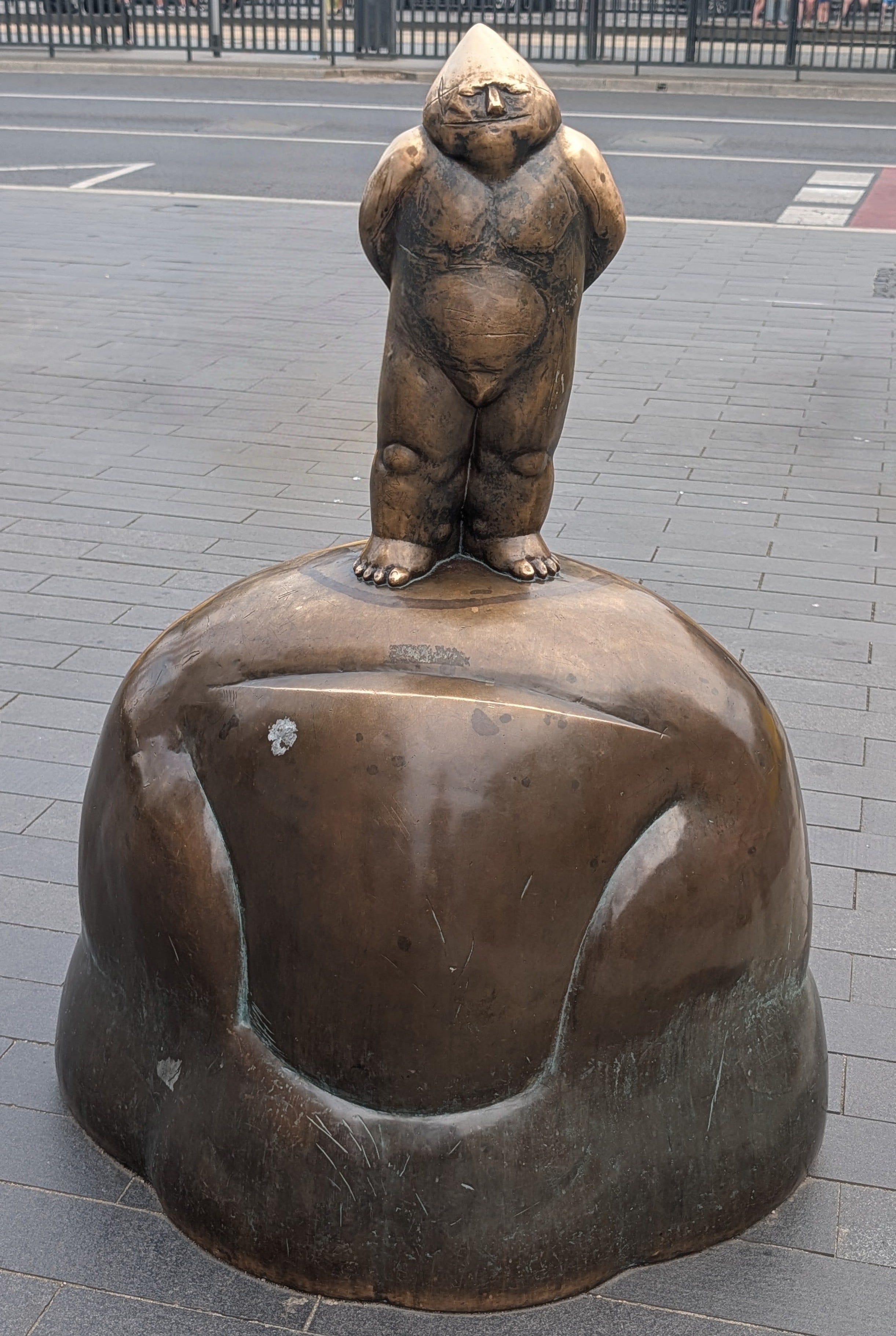
Papa Krasnal stands for resistance. Syzyfki stand for perseverance. Others have come to stand for kindness, inclusion, work, learning, and countless pieces of the community Wrocław has become.
Somewhere along the streets of Wrocław, I started thinking about what my dwarf would represent. What would my dwarf be holding? What would he be doing? Would he be who I am right now, or the person I’m still trying to become—and would those two even be the same figure?
What would yours be?
It sounds like a goofy question until you try to answer it. Reduce everything you value, everything you hope to contribute, and everything you want people to remember about you down to one small bronze figure left standing on a sidewalk long after you’ve walked past. What would be left? For most of us that’s a long, honest piece of work to figure out, and I’m still working on mine.
The story of Wrocław’s dwarfs started with a painted-over patch of wall. Someone had tried to erase what was there, and someone else decided what would take its place. Nearly half a century later, those little figures are still telling that story. Ours are still being decided—and a good place to begin is right here, picturing your dwarf: what it would hold, and what it would stand for.
“Against the assault of laughter nothing can stand.”
— Mark Twain
Connecting this quote to the story. In Wrocław, the Orange Alternative found humor could do what confrontation could not—strip an oppressive system of its power by making it impossible to take it seriously.
This week’s Chasing Influence tip: You may not control the wall in front of you, but you can still decide what you paint on it.