

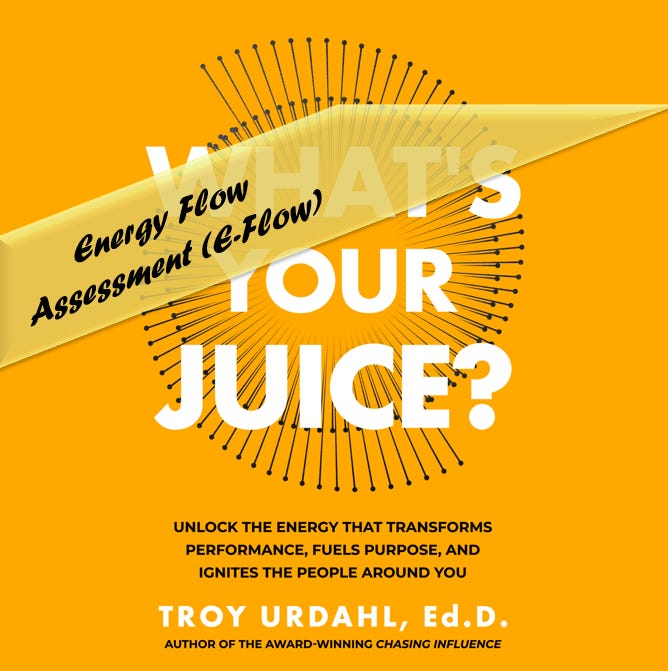
Discover how your energy influences your thoughts, actions, and the people around you.
Instructions
This Energy Flow Assessment (E-Flow) will help you identify your current energy patterns and how they influence your life. By understanding your unique “juice” signature, you’ll gain valuable insights into how you approach challenges, interact with others, and sustain motivation over time.
Answer the following questions based on how you typically feel and behave. Be honest—this is for your growth! Use the scale provided for each question.
Scoring Guide
1 = Almost never true
2 = Rarely true
3 = Sometimes true
4 = Often true
5 = Almost always true
Section 1: Energy Awareness
____ I am aware of the energy I bring into conversations and interactions.
____ I can quickly identify when my energy shifts (e.g., from positive to negative or vice versa).
____ I regularly reflect on how my energy impacts my performance and relationships.
Section 2: Energy Intensity & Focus
____ I bring high energy and enthusiasm to tasks that are important to me.
____ I can stay focused and energized even when tasks become challenging or repetitive.
____ When facing setbacks, I tap into my internal drive to keep going.
Section 3: Energy Contagion – Impact on Others
____ I notice how my energy affects the mood of the people around me.
____ People often tell me that my passion or enthusiasm inspires them.
____ I make a conscious effort to uplift the energy of my teams, family, or friends.
Section 4: Energy Recovery & Balance
____ I know when to rest and recharge to avoid burnout.
____ I engage in habits that restore my energy (e.g., exercise, meditation, hobbies).
____ I can recover quickly from stressful experiences without losing my energy.
Scoring and Interpretation Guide
49 – 60: Fully Charged
Your juice is powerful and contagious! You have strong energy awareness and balance, and you inspire those around you. Focus on refining your energy for even greater impact.
37 – 48: Flowing Strong
You bring solid energy but may lose focus under pressure or forget to recharge. Identify the areas where your energy dips and develop habits to maintain your momentum.
25 – 36: Inconsistent Current
Your energy fluctuates. You have moments of strength but may struggle with consistency. Focus on building routines that support your energy and resilience.
13 – 24: Low Battery
Your energy levels may be draining quickly or be influenced by negativity. Reflect on what depletes you and implement strategies for recovery and positive energy cultivation.
Below 12 Energy Crisis
You may be experiencing burnout or disconnection from your purpose. It’s time to pause and reset. Focus on the reflection questions and next steps below before revisiting chapter one and begin setting a plan to restore your energy.
Reflection Questions
Awareness: How conscious are you of your energy patterns?
Response: Do you maintain energy through obstacles?
Transfer: How well do you uplift and energize others?
Sustainability: Are you connecting to a deeper purpose to fuel long-term energy?
List the top three areas needing attention:
___________________________________________________
___________________________________________________
___________________________________________________
Next Steps: Your E-Flow Journey
Set Your Focus: Commit to strengthening one area (Awareness, Response, Transfer, or Sustainability).
Daily Energy Check: Pause throughout the day to ask, “What’s my juice right now?”
Small Wins: Celebrate moments where you maintained or regained positive energy.
Accountability Partner: Share your goal with someone who can encourage your progress.
Revisit and Reflect: Retake this assessment after 30 days and track your improvement.
Your energy shapes not only your experience but the world around you. Keep bringing the juice!
This assessment is intended as a reflective and developmental reference tool, designed to offer insights into energy patterns and influence dynamics. It is not a clinical, psychological, or psychometric assessment, nor has it undergone formal clinical validation or testing. Results should be interpreted as guidance for self-awareness and growth, rather than as diagnostic conclusions.