

“Whenever you feel like criticizing any one … just remember that all the people in this world haven’t had the advantages that you’ve had.”
— F. Scott Fitzgerald, The Great Gatsby
Chasing Influence: Transformational Coaching to Build Champions for Life and What’s Your Juice? Unlock the Energy that Transforms Performance, Fuels Purpose, and Ignites the People Around You are available on Amazon and Audible!
Check the Lighting
The exit came up out of nowhere.
Well, it wasn’t out of nowhere. It was exactly where it had always been. I just didn’t realize it because I was relying on my maps app, and my phone and my car had apparently stopped speaking to each other. The Bluetooth dropped, the directions went quiet, and by the time I figured it out I was two lanes over from my exit.
I checked the mirror, flipped on the signal, and worked across the busy interstate. Quickly. Nobody slammed on their brakes and nobody got hurt. Still, I’m quite sure at least a couple of drivers behind me formed a strong opinion about my driving abilities, and I’m equally confident neither of them assumed it was the Bluetooth issue I had attributed as the root cause of my driving problems.
It wasn’t until I was down the ramp that I used my personal rearview mirror. If somebody had cut across two lanes in front of me, what would I have thought? Would I have figured his phone had disconnected from his car and that must be the reason for the abrupt lane change?
Probably not. I’d have wondered where this guy learned to drive.
Somehow, the train of thought got me thinking about illusions.
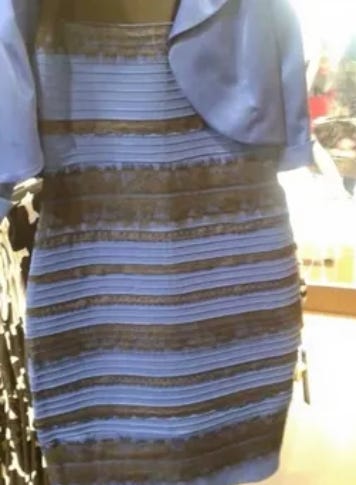
In February 2015, a woman in England snapped a photo of a dress she planned to wear to her daughter’s wedding and sent it to her daughter. The two of them couldn’t agree on what color it was. Within days, the rest of the planet was arguing about it, too.
You might remember it. Some people looked at that photo and saw a white dress with gold. Others saw blue and black and struggled to understand how anyone saw something else. Taylor Swift weighed in. Families looked at the same phone and walked away convinced the other half of the family needed an eye exam.
The dress was blue and black. So why did so many people see something else? The photo was washed out and gave no clear clue about the lighting, so each person’s brain filled in the missing details on its own. Research from NYU found that people who assumed the dress was sitting in shadow or daylight tended to see white and gold, while people who assumed it was under indoor lighting tended to see blue and black. Each brain supplied the circumstances it couldn’t see, then reported the result with total confidence.
When’s the last time you saw something totally differently than the rest of the room? And what did you make of the people who didn’t see it your way?
Unfortunately, our first instinct usually isn’t curiosity. Back in 2015, very few white-and-gold people stopped to wonder what lighting the blue-and-black people were picturing. They mostly wondered how they could possibly see anything different.
In 1971, psychologists Edward Jones and Richard Nisbett described what's now called the actor-observer bias. When we're the ones doing something, we tend to explain it by the situation. When we're watching someone else do the same thing, we tend to explain it by their character. I know my whole story on that highway - the unfamiliar road, the dropped Bluetooth, a decent enough driver in a bad spot. The drivers behind me doesn’t know any of that. They see one car and a couple of hurried lane changes and fill in the rest.
It’s the dress all over again. We fill in an awful lot of blanks about other people, and we don’t often fill them in with grace. The parent who fires off a heated email after a tough loss is unreasonable. We don’t know about the week that family has had. The kid who’s been flat at practice for three days doesn’t care anymore. Maybe … or maybe something is happening at home.
None of this means every behavior has a good explanation, or that accountability goes out the window. Sometimes the guy who cuts you off really can’t drive. There’s a big difference, though, between seeing what someone did and deciding you know why they did it. Before we cast aspersions, it’s worth walking around to the other side of the elephant. Ask a question, and give people the same benefit of the doubt we hand ourselves without even thinking about it.
Think about how many cars you pass on a normal trip across town. Hundreds, easily. Nearly every one of those drivers stays in their lane, stops when they’re supposed to, leaves a little room for someone to merge, and gets where they’re going without making any impression on us at all. Then one person cuts us off, and that’s the one we’re still talking about at dinner.
Nobody has ever come home and said, “You won’t believe it. This guy merged onto I-94 perfectly today.”
We notice what we’re looking for. Go looking for rudeness and outrage and the world will happily give you enough to fill your day, and your phone will be glad to help if you’re ever running short of ideas to be upset about. There’s plenty of good out there, too. It just doesn’t always honk at you.
Coaches can fall into the same trap. We can spend an entire practice correcting the one player who’s out of position and never mention the ten who were exactly where they belonged. Meanwhile there’s a sophomore picking up trash in the dugout that she didn’t drop, and a senior staying late to throw extra passes to a JV kid, and nobody’s saying a word to either of them because nothing went wrong.
So cut the world a little slack. The driver in front of you might be a bad driver. He might also be a guy whose Bluetooth just quit on him, two lanes from his exit, doing the best he can.
Know what you’re looking for. Next time you start to judge, ask yourself what lighting might be missing.
“People generally see what they look for, and hear what they listen for.”
— Harper Lee, To Kill a Mockingbird
Connecting this quote to the story. What we choose to look for shapes what we see, whether that’s the one bad driver, someone else’s shortcomings, or the good that was there all along.
This week’s Chasing Influence tip: Look for what’s good - what you notice most often is usually what you’re looking for.