
“To lead people, walk beside them.”
— Lao Tzu
What’s Your Juice? Unlock the Energy that Transforms Performance, Fuels Purpose, and Ignites the People Around You is now available on Amazon and now on Audible!
Championship Actions are Louder than Words
The torch is lit, and we have two more weeks of the winter Olympics to enjoy—filled with world-class competition and heart-warming stories.
One story most know well will be told again. An unlikely group of American college hockey players. A dominant Soviet team. A gold medal that changed sports and history.
People know about the underdog story. Many know about the relentless conditioning, the bag skates, and the mental toughness that defined the 1980 U.S. Olympic hockey team. Some might even know the name Ralph Cox, the final player cut from the roster—the one who came within inches of experiencing the Miracle on Ice. And of course, there was Herb Brooks.
What few people know is that Herb Brooks understood the pain of sports better than anyone.
In 1960, Brooks was the last player cut from the U.S. Olympic team, which would go on to win gold without him. He knew what it felt like to be close enough to touch greatness and still be left behind, and he carried that understanding with him for the rest of his life.
Twenty years later, that memory resurfaced at the peak of his coaching career.
The United States was on the cusp of defeating Finland to capture the gold medal at the 1980 Olympics. As the final seconds ticked off the clock, Al Michaels counted down history. Gloves, sticks, and helmets littered the ice. Fans jumped over the glass. An enormous American flag was unfurled, and the celebration became a blur of noise and unfettered joy.
And in the middle of it all, Herb Brooks snuck away to find some quiet.
He quickly hugged his assistants, turned away from the ice, and quietly walked off the bench toward the locker room while everyone else celebrated.
For years, people wondered why. Why didn’t he stay? Why didn’t he rush the ice and celebrate with his players? Why didn’t he soak in the moment he had spent his entire life chasing? What was he thinking about?
Years later, Brooks was asked that last simple question: “When the final seconds ticked down, and you knew you were going to win the gold medal, what were you thinking about?”
The answer was unexpected. “I was thinking about Ralph Cox.”
He was about to win the gold medal and what was he thinking about? The last guy he cut from the team. Ralph Cox, the young man whose Olympic dream ended when Brooks cut him. Every leader can relate to that type of moment—maybe not of that magnitude, but we know the feeling.
Herb Brooks is often described as cold, stern, demanding, and intimidating. Those descriptions aren’t wrong. He was brilliant, calculated, and relentless. He pushed people to places they didn’t believe they could go. But in that moment, at the pinnacle of success, what surfaced wasn’t ego. It was empathy. It was memory. It was an understanding of the human cost that comes with leadership decisions.
He knew exactly what that felt like, because years earlier, he had been on the other side of that conversation.
Great leaders don’t erase pain. They acknowledge it, remember it, and allow it to inform how they lead, without letting it define them.
I didn’t understand that about Herb Brooks from Olympic footage or highlight reels. I was too young for that. I learned it years later on a cold night in the Willmar (Minn.) Civic Arena in the winter of 1986–87.
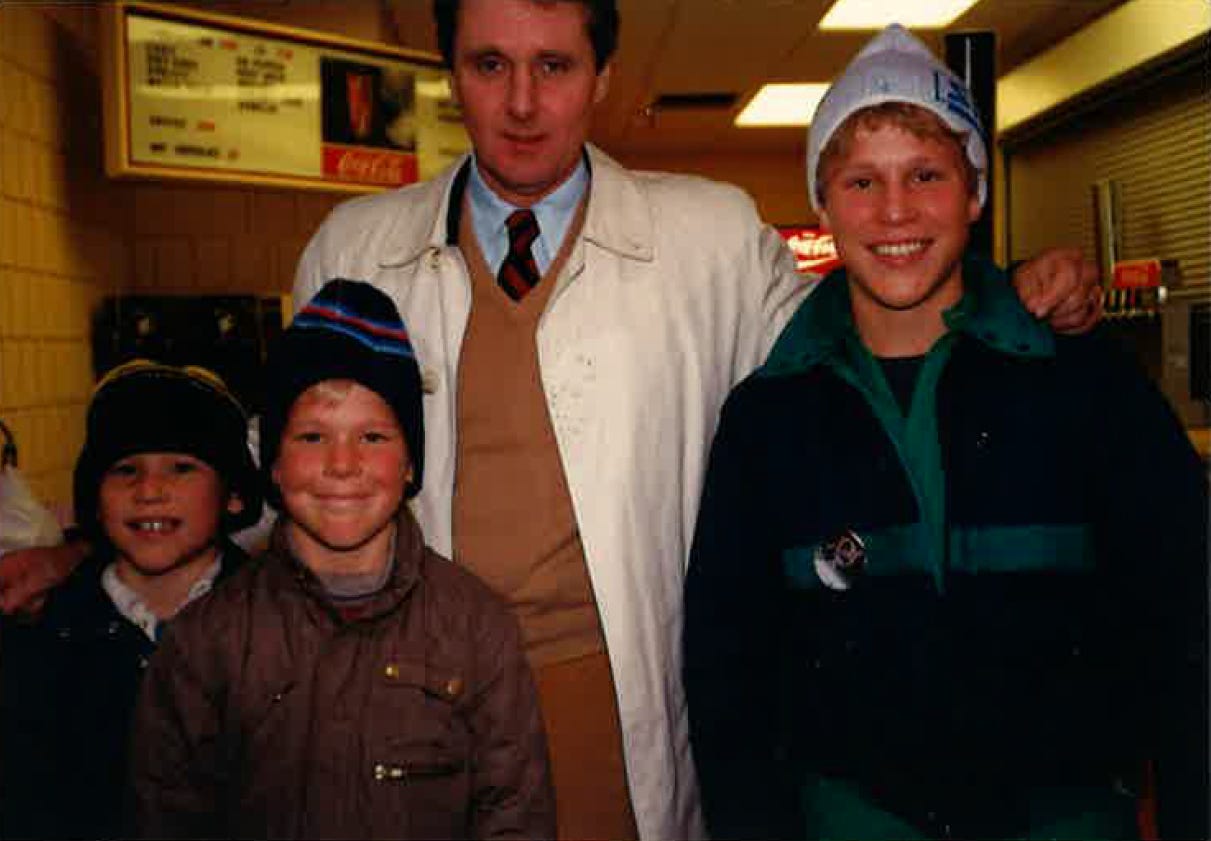
Brooks had recently been let go as the head coach of the New York Rangers and had returned to Minnesota to coach at St. Cloud State, helping lay the groundwork for the program’s transition from Division II to Division I. That night, with our breath fogging in the cold arena air, he wasn’t there as part of some promotion. He was avoiding attention and was simply watching a game.
Along the way, my keen-eyed brothers and I spotted him near the concession stand. He couldn’t have been nicer as he stopped, put his arms around us, and smiled for a photo with my brothers and me. It was just a small moment of humanness in a cold rink.
That’s the image of Herb Brooks that has stayed with me.
Leadership isn’t defined by the moments everyone sees. It shows up in the ones they don’t see. And when you succeed, pay attention to who you were thinking about when you got there.
As the celebration unfolded in 1980, Herb Brooks’ thoughts drifted away from the ice. Ralph Cox wasn’t part of the final roster, but his contributions and the standard he represented were still part of his story. And now, it’s part of our story.
Great leaders remember the ones who helped shape the moment, even if they weren’t there to celebrate it.
That’s influence. And it’s worth chasing.
“The best way to find out if you can trust somebody is to trust them.”
— Ernest Hemingway
Connecting this quote to the story. Coaching and leadership require trusting people with outcomes you can’t control, and living honestly with the consequences of that trust.
This week’s Chasing Influence tip: Remember all the people behind the outcome.