
“Well done is better than well said.”
— Benjamin Franklin, Poor Richard's Almanack, 1737
Last week’s post was about Brian Epstein seeing what the Beatles could be before anyone else … belief was his gift. This week is about the harder part that comes after, when an idea has to be carried, by hand, into a country that hasn't heard it yet.
Chasing Influence: Transformational Coaching to Build Champions for Life and What’s Your Juice? Unlock the Energy that Transforms Performance, Fuels Purpose, and Ignites the People Around You are now available on Amazon and Audible!
Before the Ink Dried
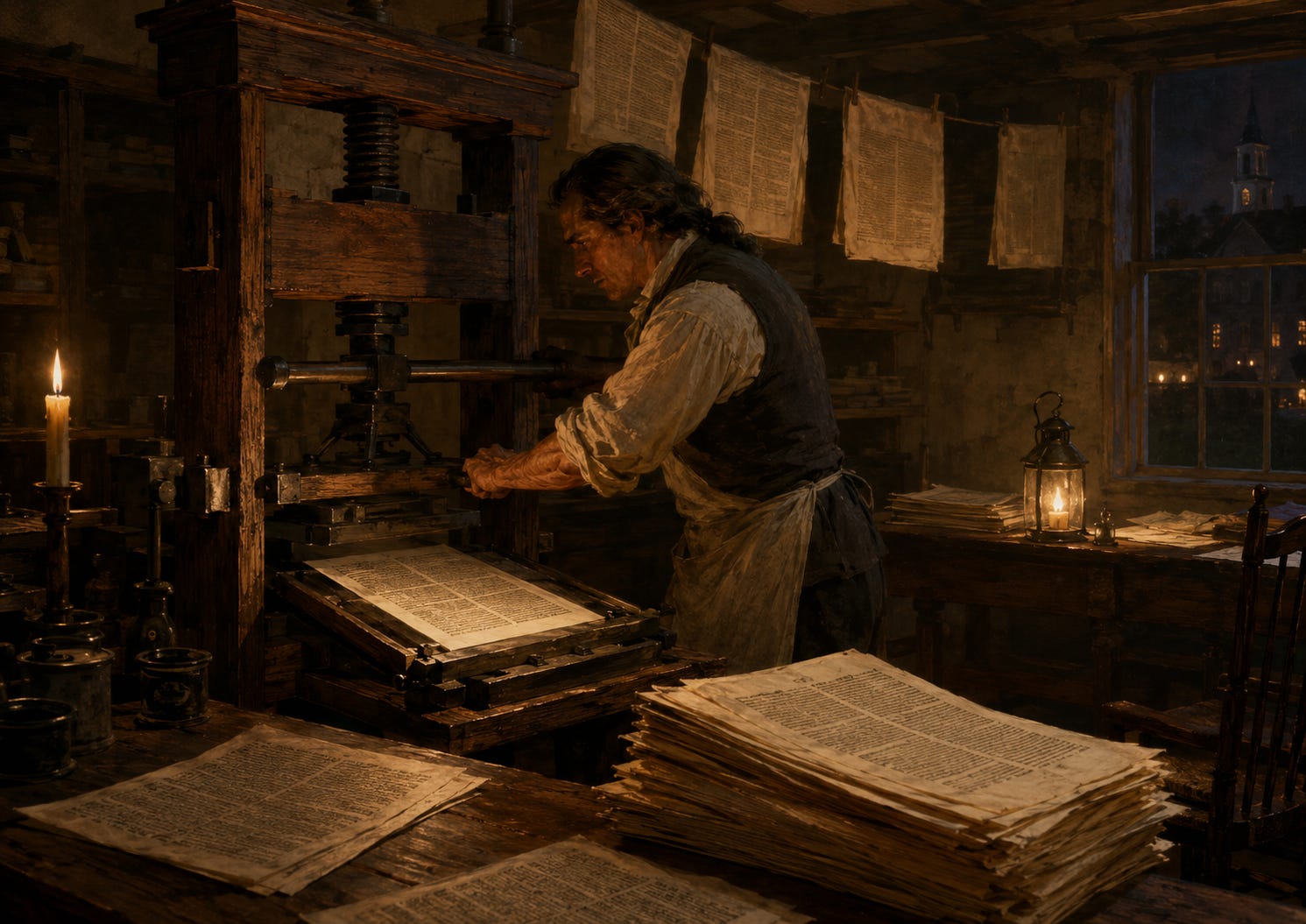
A Colonial printing press needed both hands and a strong back. By the time the candles burned low, John Dunlap had been working at one for hours.
Dunlop was a twenty-nine-year-old Irish immigrant. A Philadelphia printer trusted with Congress’s most urgent work … which on this night, July 4th, 1776, meant someone had handed him a single sheet of handwriting and told him to make a lot of it.
So he set the type, letter by letter. He inked the press, pulled the sheets, stacked them, folded them, and sent them into the world before they even had time to dry. Some copies were folded before the ink had fully set, so the margins shifted, and the form sat a little unevenly in the press. It was a job too urgent to worry about perfection.
The whole process had been rushed. “We were all in haste,” John Adams later remembered.
This is the first of a two-part series I will post over the next two weeks. The country turns two hundred and fifty this Fourth of July, and I’m going to dust off a couple of stories most people don’t know.
What Dunlap printed that night is not the document you’re picturing. The one you know, the tall parchment under glass at the National Archives with its famous signatures, didn’t exist yet. It wouldn’t be signed until August.
What most people actually saw in the summer of 1776 was one of Dunlap’s rough sheets. No one knows exactly how many came off the press, probably somewhere around 150 to 200. Twenty-six are known to survive.
These were the copies that began going out on July 5th to assemblies, conventions, committees of safety, and military commanders. On July 8th, a man named John Nixon climbed onto a platform behind the Pennsylvania State House and read the words aloud to a crowd for the first time. On July 9th, they were read to Washington’s troops in New York.
The words of the Declaration of Independence didn’t change anything. It was the actions that followed those words. Someone printed its copies through the night. Someone saddled a horse to share those copies and someone stood in a public square to read it where people could hear. Someone in that crowd was inspired to do something about it.
An idea on paper is just an idea. It needs a carrier. This is always true about the things we write down. The purpose statement, the core values on the wall, the standards we espouse.
We’ve all written plenty of them … and probably watched them sit there and collect dust. The words are never the hard part, the doing is.
It happens in the hallway, at the dinner table, in the meeting after everyone is tired, in the text you send to check on someone, in the apology you finally offer, in the standard you hold when it would be easier to look away. It happens in the drill you run for the four hundredth time, the conversation you would rather avoid, the small act of service nobody will notice, and the way you treat the person who has nothing to offer you in return.
Most of us remember the signers, not the printer. We remember Hancock, not Dunlap. But there is no Fourth of July without that original piece of paper being brought to life. Similarly, there is no team, no classroom, no family, no organization that lives by its values just because somebody wrote them down beautifully. Values live only when somebody carries them out of the room.
Two hundred and fifty years later, we have the same great example to follow. The great American experiment without follow-through would only be words.
“Ideas won't keep. Something must be done about them.”
— Alfred North Whitehead
Connecting this quote to the story. John Dunlap’s overnight printing of the Declaration was what “something must be done” looked like in real time.
This week’s Chasing Influence tip: Values have to be more than words on paper. They come to life in the people willing to carry them out of the room.