
“Those who expect to reap the blessings of freedom, must, like men, undergo the fatigues of supporting it.”
— Thomas Paine
Last week's post was about John Dunlap printing the Declaration through the night … carrying the idea was his part. This week is about the harder test that came after, when the celebrating stopped and the army that declared independence had to decide whether it meant it.
Next week, we will return to exploring new topics and ideas related to how we live our lives.
Chasing Influence: Transformational Coaching to Build Champions for Life and What’s Your Juice? Unlock the Energy that Transforms Performance, Fuels Purpose, and Ignites the People Around You are now available on Amazon and Audible!
After the Declaration
The rope pulled tight, and the king began to lean.
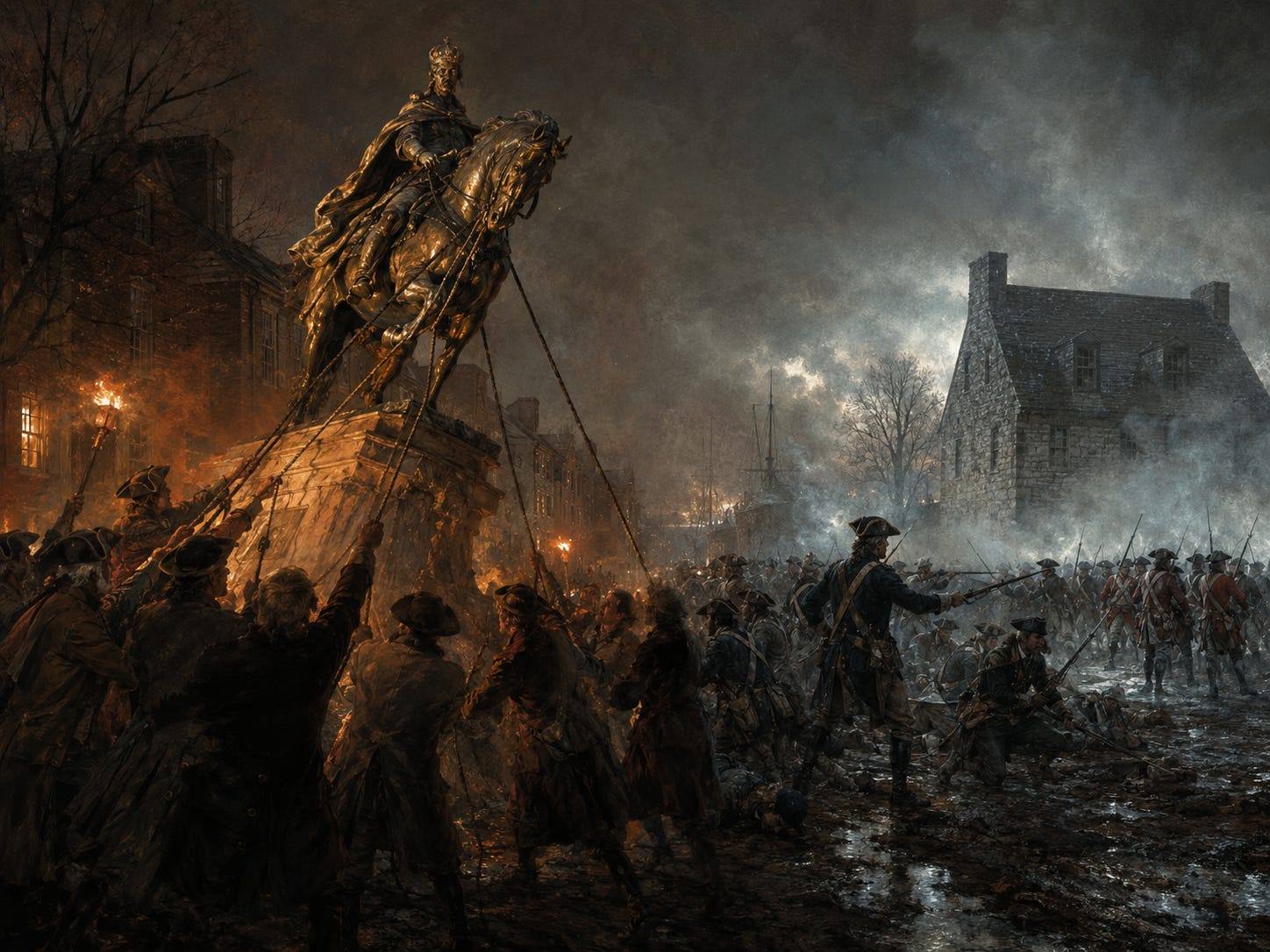
It was the night of July 9, 1776, at the bottom of Broadway in New York. Hours earlier, the Declaration of Independence had been read aloud to Washington’s army. One of Dunlap’s rough printed sheets had reached General Washington. A crowd of soldiers and sailors had assembled in a little park called Bowling Green, throwing ropes over a gilded statue of King George III on horseback.
Four thousand pounds of lead. Six years on that pedestal, watching over the city. The king’s statue was a daily reminder of who ruled and who obeyed, and it tumbled down hard.
The assembled masses sawed the crowns off the fence posts and they cut the king’s head from his shoulders. And then somebody had a brilliant irony-laden thought. Lead was hard to come by, and lead was what musket balls were made of.
So the king went to Connecticut in pieces, and the women of Litchfield spent that summer melting him down. More than forty thousand rounds of ammunition were cast from the statue of the king they’d just renounced. They’d use that lead to fight for independence.
That night must have been electric. The bells, the bonfires, the yelling, and anxious energy. Independence, declared. If the story were so simple. We all know it doesn’t end there.
Seven weeks later, the same army stood on Long Island and watched the horizon fill with British sails. It was the largest expeditionary force Britain had ever sent abroad. On the morning of August 27, the redcoats came through an unguarded pass and appeared behind the American lines, and the army that had pulled down the king came apart in a morning’s time.
Men ran as whole regiments dissolved into the marshes along Gowanus Creek. Washington’s war — and maybe the country itself — was hours from ending in the first major battle after independence had been declared.
What stood between the army and annihilation was a rear guard of a few hundred men from Maryland, under a Baltimore major named Mordecai Gist. Farmers and tradesmen, most of whom had never seen combat. Their task was simple and terrible. They were to hold off the British near the stone farmhouse long enough for the others to get across Gowanus Creek and back toward the American lines.
The Marylanders charged toward the British position near the stone farmhouse. They were thrown back, reformed, and charged again. Some accounts say they made two assaults; others say as many as six.
Washington watched it through his spyglass from a hill across the creek. The story later told has him crying out, “Good God, what brave fellows I must this day lose!”
Two hundred fifty-six of them didn’t come back. History would remember them as the Maryland 400. Most of their names weren’t recorded. Two nights later, under cover of fog, Washington slipped nine thousand men across the East River, and the army that went on to win the war survived because of an hour bought by men nobody cheered.
Over the past weeks it’s been eye-opening to revisit our history and to see how issues change — in the times and magnitude — yet lessons hold true.
I’ve been part of teams that pulled down statues. The excitement of day one of the season, the lofty goals, the new standards, the slogan on the shirts. The energy is real — I felt it.
And I’ve watched the same teams meet their Brooklyn. The first loss that wasn’t supposed to happen. The starter who got hurt. The slump where nothing worked. That's when everybody finds out if you meant it.
Every team declares who it is in the celebration. It becomes who it is in the rear guard … in the practice after the blowout, in the leader who holds the standard when holding it costs something, in the coach who keeps teaching when there's seemingly nothing left to play for.
Every team gets a night at the bonfire. Not every team holds the stone house. The ones that do are truly special.
“Perseverance and spirit have done wonders in all ages.”
— George Washington
Connecting this quote to the story. Washington wrote that line a year before Brooklyn … then he witnessed the Maryland 400 prove it.
This week’s Chasing Influence tip: The standard that matters most is the one you hold after the room stops cheering.